


Helpful Terms
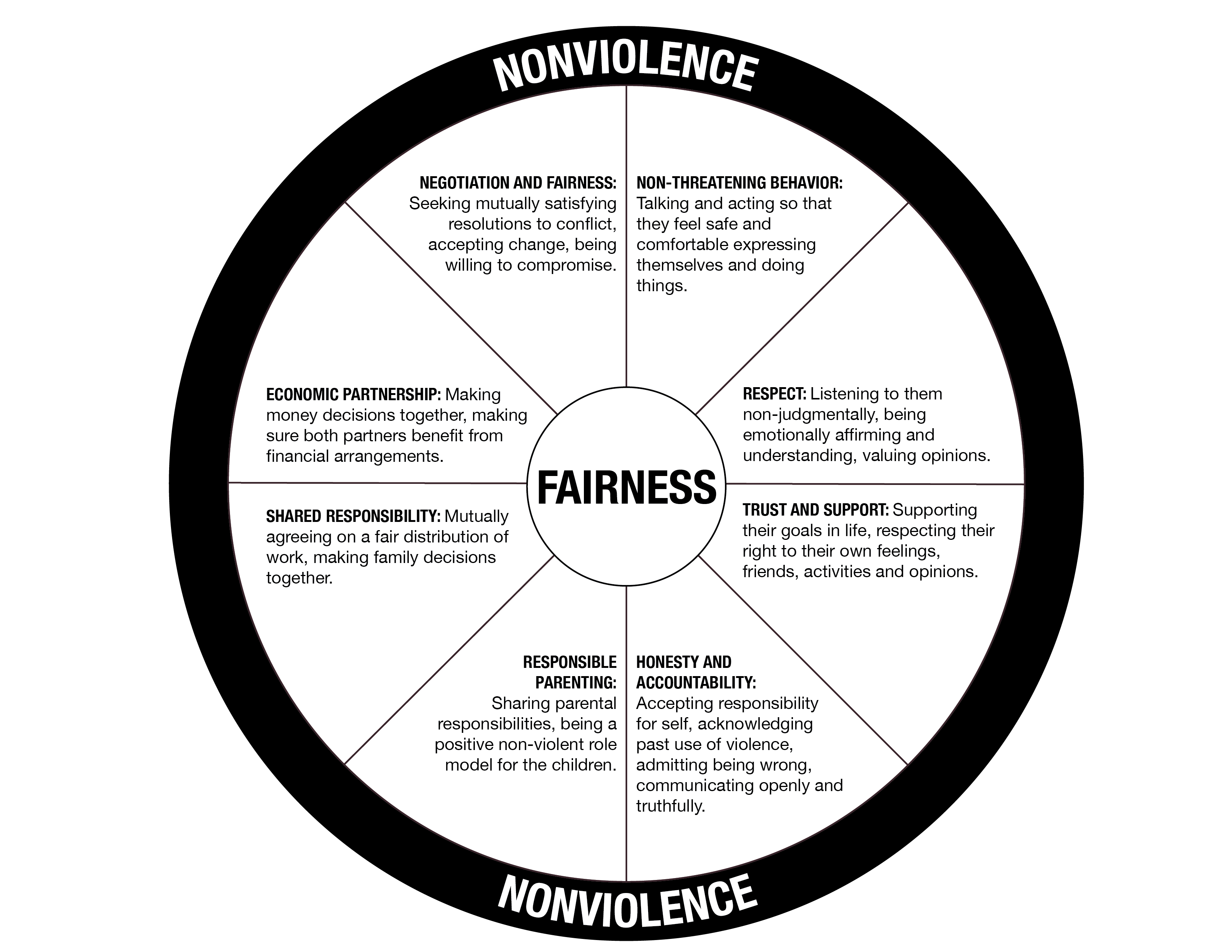
The Fairness diagram provides examples for what safe, healthy, and respectful relationships look like, which is reinforced by non-violence.
-
The Fairness Diagram
Economic Partnership: Making money decisions together, making sure both parnters benefit from financial arrangements.
Negotiation and Fairness: Seeking mutually satisfying resolutions to conflict, accepting change, being will to compromise
Non-Threatening Behavior: Talking and acting so that they feel safe and comfortable expressing themselves and doing things.
Respect: Listening to them non-judgmentally, being emotionally affirming and understanding, valuing opinions.
Trust and Support: Supporting their goals in life, respecting their right to their own feelings, friends, activities and opinions.
Honesty and Accountability: Accepting responsibility for self, acknowledging past use of violence, admitting being wrong, communicating openly and truthfully.
Responsible Parenting: Sharing parental responsibilities, being a positive non-violent role model for the children.
Shared Responsibility: Mutually agreeing on a fair distribution of work, making family decisions together.
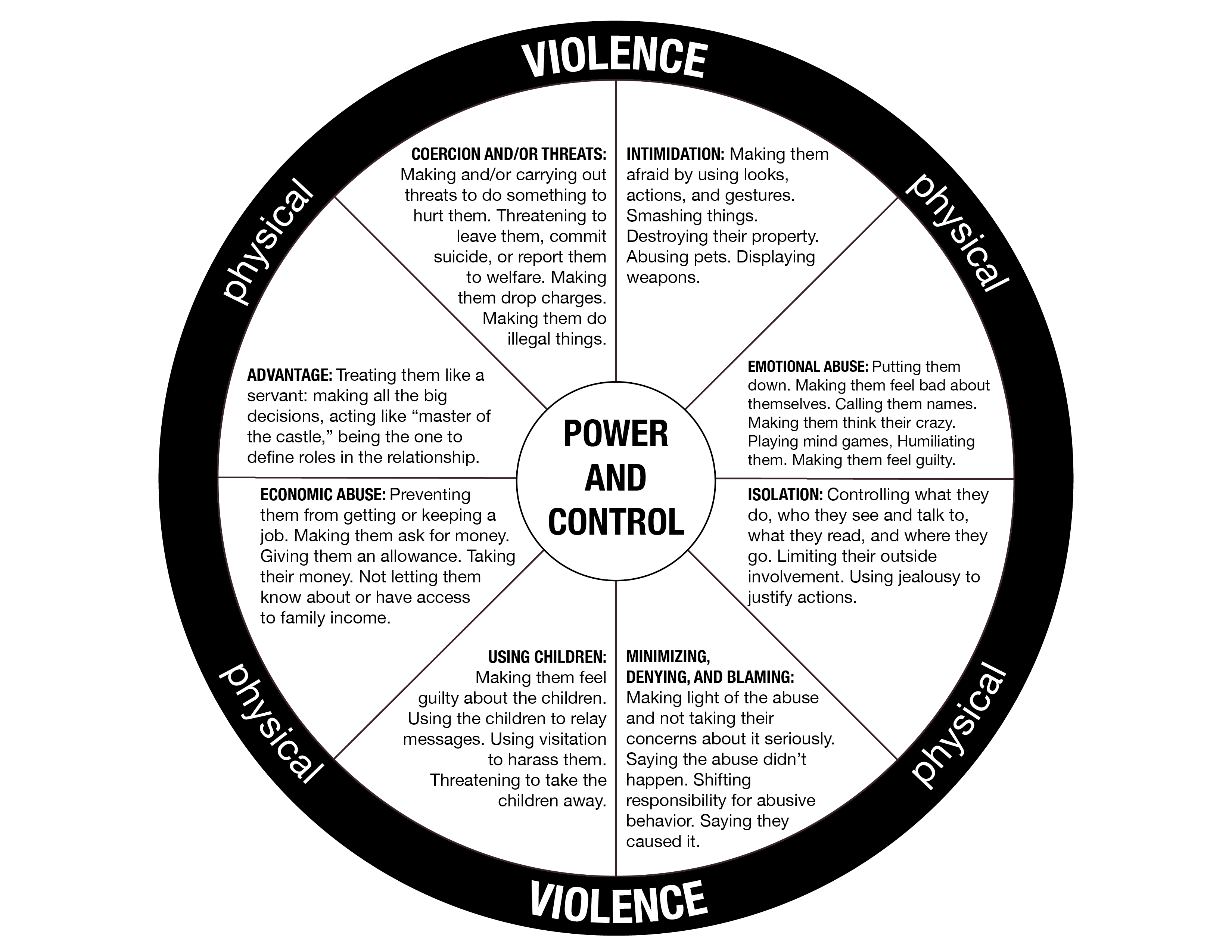
The Power and Control diagram is helpful in understanding the patterns of abuse and violence that abusers use to establish and maintain control over a partner, friend, roommate, family member, etc. The inside of the wheel contains behaviors that may start out subtle and escalate over time, while the outer ring of physical and sexual violence reinforces behaviors inside the wheel (www.theduluthmodel.org).
-
The Power and Control Diagram
Advantage: Treating another person as a servant, making unilateral decisions, acting as the authority or “master” of the household, defining roles and expectations unfairly. The diagram emphasizes that these behaviors are interconnected and work together to maintain power and control, with physical violence forming a surrounding and recurring element.
Coercion and threats: Making and carrying out threats to hurt someone, threatening to leave, report them to authorities, commit self-harm, or make them drop charges; forcing someone to do illegal acts.
Intimidation: Making someone afraid through actions such as using threatening looks, actions, or gestures; smashing belongings; destroying property; abusing pets; displaying weapons.
Emotional abuse: Putting someone down, making them feel bad about themselves, calling them names, making them think they are “crazy,” playing mind games, humiliating them, or making them feel guilty.
Isolation: Controlling what someone does, who they see and talk to, what they read, and where they go; limiting outside involvement; using jealousy to justify controlling actions.
Minimizing, Denying, and Blaming: Making light of the abuse, refusing to take concerns seriously, saying the abuse did not happen, shifting responsibility, or saying the other person caused the behavior.
Using children: Making others feel guilty about children, using children to relay messages, threatening to take children away, or undermining parental roles to maintain control.
Economic abuse: Preventing someone from getting or keeping a job, controlling money, giving an allowance, taking earnings, or not letting someone know about or access household income.
-
Coercion
Coercion involves the absence of free and informed consent; often relying on one person having power or influence over another, which they exploit to get their way. Coercion involves manipulation and verbal pressure. It is perpetrated without using physical force.
-
Control
Controlling behaviors involve a person trying to gain and maintain power and control of another person, and can look like the restriction of autonomy or independence.
-
Emotional Abuse
Emotional abuse includes non-physical behaviors that are meant to control, isolate, or frighten. This may present as threats, insults, constant monitoring, excessive jealousy, manipulation, humiliation, intimidation, and dismissiveness. Emotional abuse can appear more obvious, like a partner yelling or name calling. Other times it can be more subtle, like a partner acting jealous of friends or not wanting their partner to hang out with other people and making them feel bad about having their own extra-curricular activities or hanging out with friends (thehotline.org).
-
Jealousy
Jealousy is a common issue in many relationships. It’s normal to feel some jealousy with our partners, but what determines if a person’s relationship behaviors are healthy, unhealthy or abusive is how they deal with their jealous feelings. It’s important to understand and unpack the different myths of jealousy. Learn more about how to confront your own jealousy in a healthy way (https://www.thehotline.org/resources/the-myths-of-jealousy/ ).
-
Intimidation
Intimidation looks like frightening someone with gestures, looks, or actions, such as breaking things and damaging property.
-
Stalking
Stalking refers to harassing or threatening behavior that an individual engages in repeatedly; causing the victim to fear for their safety or experience emotional distress.
-
Gaslighting
Gaslighting is when your emotions, words, and experiences are twisted and used against you, causing you to question your reality. This can be a very effective form of emotional abuse, because once an abusive partner has broken down your ability to trust your own perspective, you may be more vulnerable to the effects of abuse, making it more difficult to leave the abusive relationship (thehotline.org).
-
Love Bombing
Love Bombing is an attempt to influence another person with over-the-top displays of attention and affection.” This kind of behavior is a form of emotional abuse, and although it can be experienced during any stage of a relationship, it is often seen in the early stages of getting to know one another. It may seem like your new partner really likes you but love bombing can often serve as a warning sign of an unhealthy relationship.
Ultimately, you are the only one who knows what makes you feel comfortable and what does not. We know that all relationships exist on a spectrum from healthy to abusive, so it always helps to check in with yourself and decide if you need to speak to your partner about your concerns (thehotline.org).
-
Reproductive Coercion
Reproductive coercion is a form of power and control because one partner takes away reproductive health decisions and options from the other. Examples of reproductive coercion include:
- Refusing to use a condom or other types of birth control.
- Removing a condom during intercourse (also known as stealthing).
- Withholding finances needed to purchase birth control (a form of financial abuse).
- Threatening their partner or becoming violent if they don’t follow their wishes to either end or continue a pregnancy.
-
Financial Abuse
Financial abuse is rooted in the desire of one partner to have power and control over the other. A partner who chooses to abuse will control their partner’s finances or their ability to provide for themselves through a job or public assistance they receive. Examples of financial abuse include:
- You have a joint bank account, and your partner monitors your spending and yells at you for every purchase.
- Your partner gives you an allowance, and you are only allowed to spend that money on what they need.
- Your partner affects your ability to work, such as causing you to be consistently late or preventing you from going to work some days, leading to issues or potential firing.
- Your partner receives your public assistance check and refuses to give it to you.
- Your partner takes any money earned from you and controls where you spend it.
-
Technology-facilitated Abuse
Technology-facilitated abuse, also known as online abuse, is the use of technology, image-based sexual abuse (IBSA), sextortion, intimate partner surveillance, and online spaces (e.g. social media) to bully, harass, stalk, intimidate, or control a partner. This behavior is often a form of verbal or emotional abuse conducted online (thehotline.org).
-
Sexual Violence
Sexual Violence is when someone forces or manipulates someone else into unwanted sexual activity without their consent. Reasons someone might not consent include fear, age, illness, disability, and/or influence of alcohol or other drugs. Anyone can experience sexual violence. Sexual violence can occur within intimate relationships, by acquaintances, trusted individuals, or strangers (thehotline.org).
-
Physical Abuse
Physical Abuse involves the use of physical violence, or threats of it, to maintain power over an individual. Because of this, survivors are afraid and uncertain when more abuse will occur. This often reinforces the regular use of other, more subtle, types of abuse (thehotline.org)